Pricing strategies for beginner freelance graphic designers to maximize earnings online
How Beginner Graphic Designers Should Price Their Services to Scale Online
Getting pricing right is one of the fastest levers a new freelance graphic designer can pull to increase income, reduce stress, and build a sustainable online business. This guide walks you through a practical pricing philosophy, how to craft scalable packages, the profitability math you can actually use, when to charge by value versus hours, building retainers for steady cash flow, protecting margins with scope controls, and testing your positioning in the market. ⏱️ 9-min read
Every section includes concrete examples, client-facing language, and small templates you can copy. If you’re launching a portfolio or moving from one-off gigs to repeat clients, these steps will help you price with confidence—so you earn more while doing better work.
Pricing philosophy and model selection
Start by writing down what you want from freelancing: a monthly income target, how many billable hours you’ll accept, and how many active projects you can manage without dropping quality. These boundaries shape every pricing decision. For example, if you want $4,000/month and can bill 80 hours, your target billing rate before overhead is $50/hour; after costs and buffers it will be higher. The clarity stops price-by-email reactions and prevents low-value work from eating your schedule.
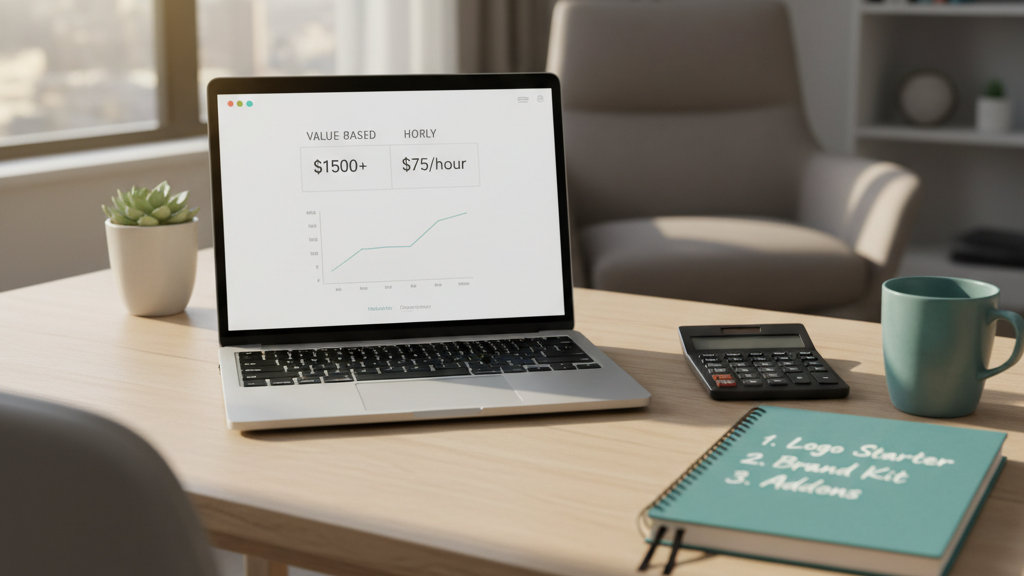
Choose a primary pricing model and keep a simple fallback for small or undefined jobs. Three common models work well together: project-based (fixed price), hourly, and value-based. Project-based pricing is ideal for well-scoped packages—logo design, landing-page assets, or a basic brand kit—because it’s predictable for both sides. Hourly pricing fits ongoing maintenance, uncertain scopes, and ad-hoc requests. Value-based pricing sets fee by the outcome you create (brand clarity, higher conversion), and it’s the model that lets you command premium rates.
Adopt a pricing stance that you can explain in plain language—something like: “I price by the impact I deliver, with hourly as a safety net for open-ended work.” State your position on discounts and volume: avoid the “cheapest wins” trap. Discounting trains buyers to expect less value; structured packages and occasional launch promotions work better. Finally, document these rules in a short pricing policy you keep in your proposal template—this brings discipline and consistent earnings.
Create scalable service packages
Packaging is the bridge between you and buyers scrolling marketplaces. Instead of selling “design time,” create three clear tiers—Starter, Standard, and Pro—with specific deliverables, timelines, and exclusions. A Starter Logo Kit might include one concept, one round of revisions, and vector files for $650. Standard could add a secondary mark, a color palette, two revision rounds, and social templates for $1,400. Pro becomes a Brand Kit: multiple concepts, a mini style guide, font recommendations, and collateral templates for $2,800+
Each package should list exact inclusions (file types, number of concepts, revision rounds) and explicit exclusions (stock license costs, website development, copywriting). Add clear timelines—e.g., “Initial concepts delivered in 5 business days; final files within 7 days after approval”—and decision milestones so client delays are accounted for. Use simple add-ons to boost average order value without muddying the core scope: expedited delivery (+25–50%), extra revision rounds (+$100–$250), social media asset packs (+$150–$400), or a full brand guide (+$500–$1,200).
Price packages against fixed-effort estimates and keep a margin buffer. Estimate the hours for each package component—discovery, concepting, revisions, finalization—and multiply by your target hourly equivalent (from your profitability math). As you grow, track actuals and adjust estimates. A scalable package system helps you sell faster, automate proposals, and offer buyers a clear path to upgrade their commitment.
Profitability math: time, costs, and rates
Don’t guess your rate—calculate it. Start by listing monthly direct costs: Adobe Creative Cloud or Figma ($20–60), stock assets ($10–100 per month on average), fonts and licenses, cloud storage ($10–30), and domain/email costs. Add overheads: taxes, accounting, hardware amortization, and non-billable time for admin, marketing, and learning. A practical formula is:
- Target hourly rate = (monthly direct costs + allocated overhead + desired monthly profit) ÷ estimated billable hours
Then apply an overhead multiplier (typically 1.25–2.0) to account for non-billable time and unexpected expenses. Example: if your monthly costs are $500, you want $3,000 profit, and you expect 80 billable hours, base rate = ($3,500 ÷ 80) = $43.75. Multiply by 1.5 for overhead = ~$65/hr. Translate that to package pricing by estimating hours per package and adding a margin buffer (20–30%).
Break projects down into phases—discovery, design, revisions, delivery, and admin—and add a 20–30% time buffer. Track time with simple tools (Toggl, Clockify) and compare estimates to actuals monthly; this will refine your pricing accuracy. Run sensitivity checks: what happens to profit if you under- or over-estimate by 20%? These checks help you know when a fixed-price job is worth the risk or when to prefer hourly work.
Value-based pricing vs hourly: when to use each
Value-based pricing is powerful when you can tie design work to measurable business outcomes. Use it when the project affects revenue, conversion, or brand positioning: a product launch identity, a landing page expected to lift conversion, or a website redesign for lead generation. If a client expects a 20% increase in conversions from new hero imagery and on-page assets, you can confidently price a portion of your fee against that expected value—often 5–15% of the projected uplift is a reasonable starting point depending on risk and proof of impact.
Hourly pricing is appropriate for maintenance work, small tweaks, or undefined scopes that could expand. It’s transparent and protects you from scope creep. For hybrid cases, use a base project fee for core deliverables and an hourly rate for extras—this offers predictability while keeping flexibility. Example client language: “The base package covers the agreed deliverables. Any additional work outside this scope will be billed at $X/hour and requires written approval.” That phrase keeps negotiations clear.
To justify value pricing to clients, frame the conversation around outcomes rather than hours: “This brand kit will make your packaging consistent and reduce production errors, which historically reduces reprint costs by X% and speeds time-to-market.” Provide examples or benchmarks—case studies where visual clarity reduced returns or increased conversion. If you can’t quantify impact, rely on project- or hourly-based pricing until you build the evidence to charge on value.
Retainers and ongoing engagements for steady income
Retainers convert unpredictable freelance income into predictable cash flow. Structure retainers by defining a minimum monthly commitment and a clear set of deliverables: for instance, a $500/month retainer for three social templates and two rounds of minor revisions, or a $1,500/month retainer for 10 assets plus strategy sessions. Anchor ranges depend on the work: simple repeatable tasks often start at $300–600/month; comprehensive brand support or multi-channel design can range from $1,200–3,500/month for early-career designers.
Define what the retainer includes: number of hours or deliverables, response time, revisions, and meeting frequency. Specify billing cadence (monthly or quarterly), renewal terms (auto-renew with 30-day notice), and rate increases at renewal (e.g., 5–10% annual). This reduces negotiation friction and protects margins. Include a clause for out-of-scope requests—either add hours at your hourly rate or an agreed per-item fee.
Offer expansion paths so clients can grow their engagement without renegotiating from scratch: “Starter Retainer moves to Growth Retainer with an additional $500/month to include campaign assets.” Consider performance incentives—bonuses for meeting KPIs or rate adjustments if the workload consistently exceeds the retainer. Retainers reward consistency; for you, they improve cash flow and client relationships; for the client, they reduce turnaround time and lock in priority access.
Scope, revisions, and negotiation: protect margins
Clear scope language is the single best defense against scope creep. Put specifics in the proposal and contract: exactly how many concepts, what file formats, platform sizes, number of revision rounds, and which deliverables are excluded. Use statements like: “Includes 2 logo concepts, up to 2 rounds of revisions per concept, and delivery of .ai, .svg, .png, and .pdf files. Stock image licenses not included.”
Define what constitutes a revision versus a change. Revisions adjust the chosen concept; changes introduce new directions or additional functionality. Example clause: “Minor visual updates are considered revisions. Requests that change the scope (e.g., additional concepts, new deliverables, or new platforms) will require a formal change order priced at $X or billed at $Y/hour.” Maintain a change-order log—a simple table with request, impact, hours, and client signature—to keep a clear decision trail.
Negotiation tactics that preserve value: always anchor high and justify with outcomes, not hours. When a client asks to lower price, offer scope adjustments rather than discounts: remove deliverables, reduce revision rounds, or extend timelines. Use conditional discounts sparingly and tie them to clear terms—e.g., a 10% discount for full upfront payment or a package bundle discount for committing to a 6‑month retainer. When granting concessions, get something in return: a testimonial, a case study, or faster payment.
Market positioning and testing pricing
Positioning and pricing feed each other. Narrowing to a niche—industry, service, or style—lets you charge more because your offer addresses a specific need better than generalists. If you focus on branding for boutique coffee shops or app UI kits for early-stage startups, tailor your packages and examples to those buyers. That reduces comparison shopping and lets you benchmark against peers in that niche.
Benchmark rates by researching competitors, job boards, and platforms. Create a simple matrix comparing offer, price, turnaround, and additional services. This helps you spot gaps to exploit—maybe no one offers a “Starter Brand Kit” with three social templates, or perhaps everyone provides low-quality revisions. Use this data to position your package with a unique value angle—faster delivery, deeper strategy, or stronger asset handover.
Run controlled pricing tests. Offer a pilot launch (limited spots) at a slightly higher price with elevated deliverables or faster timelines. A/B test package descriptions or price points on your portfolio or gig listing and track conversion rate, time to close, and client quality. Small incremental increases (5–15%) are safer than big jumps and help you learn the market’s price elasticity. Track metrics—win rate, average deal size, margin—and iterate quarterly. Over time, this disciplined testing and clear positioning will reveal the pricing sweet spot for your specialty.
Next step: choose one package, price it using the profitability formula above, and run a 30-day pilot with tightened scope and a retainer option. Document time spent, client responses, and your win rate—then adjust. Consistent small experiments compound into higher rates, steadier workload, and a brand clients are willing to pay for.